
 Free quiz to know your sales aptitude
 Sales Pipeline Calculator

In recent years, the conversation around artificial intelligence has taken an interesting turn. We are no longer simply asking how technology can help us work, but how it can work in our place.
AI agents that sell, respond to customers, manage negotiations, make decisions, and even coordinate other AI agents.
The promise is compelling: an increasingly autonomous business in which human involvement becomes progressively less necessary.
But is this really what businesses need?
In the relentless pursuit of systems capable of replacing human work, we risk losing sight of the value of the tools that make that work possible in the first place.
Autonomy becomes the goal rather than the means
Automation is nothing new. For decades, businesses have relied on software to eliminate repetitive tasks, reduce errors, and improve operational efficiency.
What has changed is that autonomy itself increasingly appears to be a measure of innovation. The less human intervention a system requires, the more advanced it is perceived to be.
Yet autonomy and usefulness are not necessarily proportional. This is not a rejection of artificial intelligence. It is a reminder that technological potential and practical business value are two different things.
In June 2025, Gartner predicted that more than 40% of agentic AI projects would be abandoned by the end of 2027 because of rising costs, uncertain business value, or insufficient risk management.
McKinsey’s State of AI 2025 report found that 62% of respondents were at least experimenting with AI agents, while only 39% reported an impact from AI on enterprise-wide earnings before interest and taxes (EBIT).
Its subsequent 2026 report, On the Road to ROI, reveals an equally interesting picture.
While 80% of respondents report improvements in their individual productivity through AI, only 37% report a positive contribution to their organization’s EBIT.
Among organizations with annual revenues below $1 billion, the proportion of respondents scaling AI agents remained unchanged at 22%.
The technology is advancing. Individual productivity is improving. But translating these improvements into measurable business results remains a challenge.
Perhaps the question should not be how much work we can delegate to artificial intelligence, but how much value we can create by using it.
The CRM paradox in the age of artificial intelligence
The CRM market provides a particularly interesting example.
For years, businesses have looked for tools that centralize information, organize customer relationships, track sales opportunities, and coordinate the work of their teams.
None of these needs have disappeared with the arrival of artificial intelligence.
A business still needs to know which deals are open, which customers require follow-up, which quotes have been sent, which commercial terms have been agreed upon, and which activities need to be completed.
It still needs a shared organizational memory.
Yet a growing part of the technology narrative suggests that much of this could be replaced by interacting with an intelligent agent.
The paradox is that an AI agent needs precisely this information, structure, and context to operate reliably.
According to Salesforce’s 2026 State of Sales report, based on a survey of 4,050 sales professionals, 51% of sales leaders using AI say disconnected systems are slowing down their AI initiatives.
Meanwhile, 74% of sales professionals are focusing on improving the quality of their data.
These are problems that cannot be solved simply by introducing another AI agent. Before a business can intelligently automate its processes, it needs processes worth automating and information it can trust.
A practical scenario: an ordinary day in sales
Imagine a B2B company with 20 employees, five sales representatives, and several hundred customers.
A long-standing customer contacts the company to request a quote for a new order.
The request appears straightforward, but in reality it involves several variables: previous purchases, negotiated discounts, product availability, delivery schedules, payment terms, and a relationship built over several years.
Let’s consider two hypothetical approaches.
Scenario A: pursuing full autonomy
The company decides to delegate the process to several AI agents.
One agent interprets the customer’s request. Another retrieves customer information. A third prepares the quote, and a fourth handles subsequent communications.
The system can be extremely effective, provided that all relevant information is accurate and accessible, commercial rules are properly defined, and exceptions are handled appropriately.
Now suppose the customer was verbally promised an exceptional discount during their last meeting with a sales representative. That information was never recorded!
The agent prepares and sends a quote that is technically correct but commercially inappropriate.
The customer challenges the offer. The sales representative must intervene, reconstruct what happened, and issue a corrected quote.
The company must now determine not only what went wrong, but which part of the automated workflow produced the error. Automation has accelerated the process, but it has not necessarily improved the outcome.
Scenario B: using a CRM with integrated AI
The same sales representative receives the request within a CRM platform.
They can access the customer’s history, previous deals, communications, documents, and recorded commercial conditions.
Artificial intelligence retrieves the relevant information, helps prepare a response, and assists with the creation of the quote.
The sales representative reviews the details, adds the verbally agreed discount, and approves the offer.
The quote is sent, a follow-up is scheduled, and the opportunity remains visible to the entire team.
In this scenario, artificial intelligence does not replace the sales representative. It reduces the time required to perform the work while preserving human judgment where customer knowledge and commercial sensitivity matter.
Of course, a well-designed autonomous agent could also incorporate an approval step.
And that is precisely the point.
The value of the technology does not depend on whether it is called an agent, an assistant, or an automation. It depends on the quality of the process and the appropriateness of its level of autonomy.
How much work do we really need to automate?
Consider a purely illustrative example.
If five sales representatives each spend 90 minutes a day on administrative tasks, the company spends a combined 37.5 hours per week on activities that are not directly related to customer relationships.
Assuming AI could reduce this workload by half:
- 45 minutes recovered per employee per day.
- 18.75 hours recovered across the team every week.
- 900 hours recovered per year, assuming 48 working weeks.
This is a hypothetical calculation, not a measured product performance claim. Actual savings would depend on the business, its processes, and the effectiveness of the tools involved.
Nevertheless, the principle is important.
Not a single employee needs to be replaced.
The company has simply created additional capacity that can be dedicated to negotiations, new business opportunities, and customer relationships.
There is also empirical evidence supporting the value of AI-assisted work.
The academic study Generative AI at Work, published in 2025 in the Quarterly Journal of Economics, examined the introduction of an AI assistant across 5,172 customer support workers.
Access to AI assistance increased average productivity by 15%, measured in customer issues resolved per hour, with particularly significant benefits for less experienced employees.
The study demonstrates how AI can amplify human capabilities rather than necessarily replace them.
Perhaps one of the greatest opportunities presented by artificial intelligence is not reducing the number of people working in an organization, but increasing what those people can accomplish.
The hidden cost of complexity
When evaluating autonomous AI systems, businesses naturally focus on the time they might save.
Less visible is the work required to build, maintain, and supervise those systems.
Defining instructions, configuring integrations, establishing permissions, managing exceptions, monitoring costs, and verifying outcomes all require resources.
If a company eliminates two hours of operational work but introduces two hours of supervision and maintenance, it has not necessarily improved efficiency.
It has simply transformed the work.
There is also a broader economic question. The cost of deploying an AI agent is not limited to the price of the language model or the number of tokens consumed.
The total cost may include integration, monitoring, infrastructure, maintenance, error correction, security, and the human resources required to manage the system.
For some organizations, particularly those with complex processes and substantial transaction volumes, building specialized autonomous agents may be an excellent investment. For others, using established business software with integrated AI capabilities may deliver greater value with considerably less complexity.
A small manufacturing company, a distributor, or a professional services firm should not have to become an AI development company simply to benefit from artificial intelligence.
Technology should absorb complexity rather than transfer it to the customer.
The CRM as infrastructure
A CRM is not simply a collection of screens where users enter information. It is a structured representation of a company’s commercial relationships and operations.
It contains customer records, responsibilities, activities, deadlines, documents, permissions, and shared processes.
A conversation with artificial intelligence can become a new way of interacting with these resources. It can simplify access to information and make it possible to perform complex operations using natural language.
But changing the interface does not eliminate the need for the underlying infrastructure.
Even in a future where much of the operational workload is handled by intelligent agents, businesses will continue to need reliable information, consistent processes, clear responsibilities, and effective controls.
Where will customer information be stored? Where will commercial agreements be recorded? How will access permissions be managed? How will managers monitor sales performance and verify what has been done?
These requirements exist regardless of whether the work is performed by a human or an AI system.
An AI agent can become a user of a CRM. It does not necessarily become its replacement.
Artificial intelligence may therefore make CRM platforms more important rather than less relevant.
Not everything needs a conversation
There is another aspect of the current AI revolution that deserves attention:
The assumption that every interaction with software should eventually happen through a conversational interface.
Natural language is an exceptionally useful tool when a user needs to retrieve complex information, analyze data, or perform several related operations. But sometimes, clicking a button is simply faster.
Dragging a deal into another pipeline stage, checking a calendar, reviewing a quote, or looking at a sales dashboard can be more immediate through a conventional visual interface.
Imagine having to explain in natural language every small action you want to perform throughout your working day.
Would that necessarily represent progress?
A well-designed software platform should offer the most appropriate interface for each task, rather than forcing every interaction through artificial intelligence.
The ability to use AI does not mean that AI must always be used.
Measuring success beyond autonomy
As AI becomes more widespread, businesses may need to reconsider how they evaluate its effectiveness.
The number of autonomous agents deployed is not a business outcome. Neither is the number of tasks delegated to artificial intelligence.
More meaningful indicators might include:
- Time recovered from administrative activities.
- Faster response times to customers.
- Fewer operational errors.
- Improved data quality.
- Shorter sales cycles.
- Reduced software complexity.
- Greater visibility and control over processes.
- A measurable return on investment.
An organization that achieves these results with a combination of traditional software, conventional automation, and integrated AI may be more technologically effective than one operating dozens of autonomous agents without clear economic benefits.
A future where AI is simply part of the software
As the technology matures, talking about AI-powered software may eventually become less necessary.
Much as cloud technology became a standard part of business applications, artificial intelligence could become a natural component of the software we use every day.
Businesses will continue to evaluate products based on their ability to solve real problems: usability, reliability, functionality, flexibility, and measurable results.
In some situations, this will involve autonomous agents. In others, traditional automation. In many cases, intelligent tools working alongside people will be the most appropriate solution.
There is no single level of autonomy that suits every organization or every business process.
The future of business software may not belong exclusively to autonomous agents or conventional applications, but to platforms capable of combining the strengths of both.
The Onpipeline approach
At Onpipeline, we believe artificial intelligence represents an extraordinary opportunity to improve business software. But we also believe that innovation must remain connected to the practical needs of the people using it.
Our starting point is not the AI agent. It is the business.
Onpipeline is first and foremost a complete CRM platform designed to manage customer relationships, sales pipelines, deals, activities, quotes, electronic signatures, invoices, and commercial processes.
These capabilities have value independently of artificial intelligence.
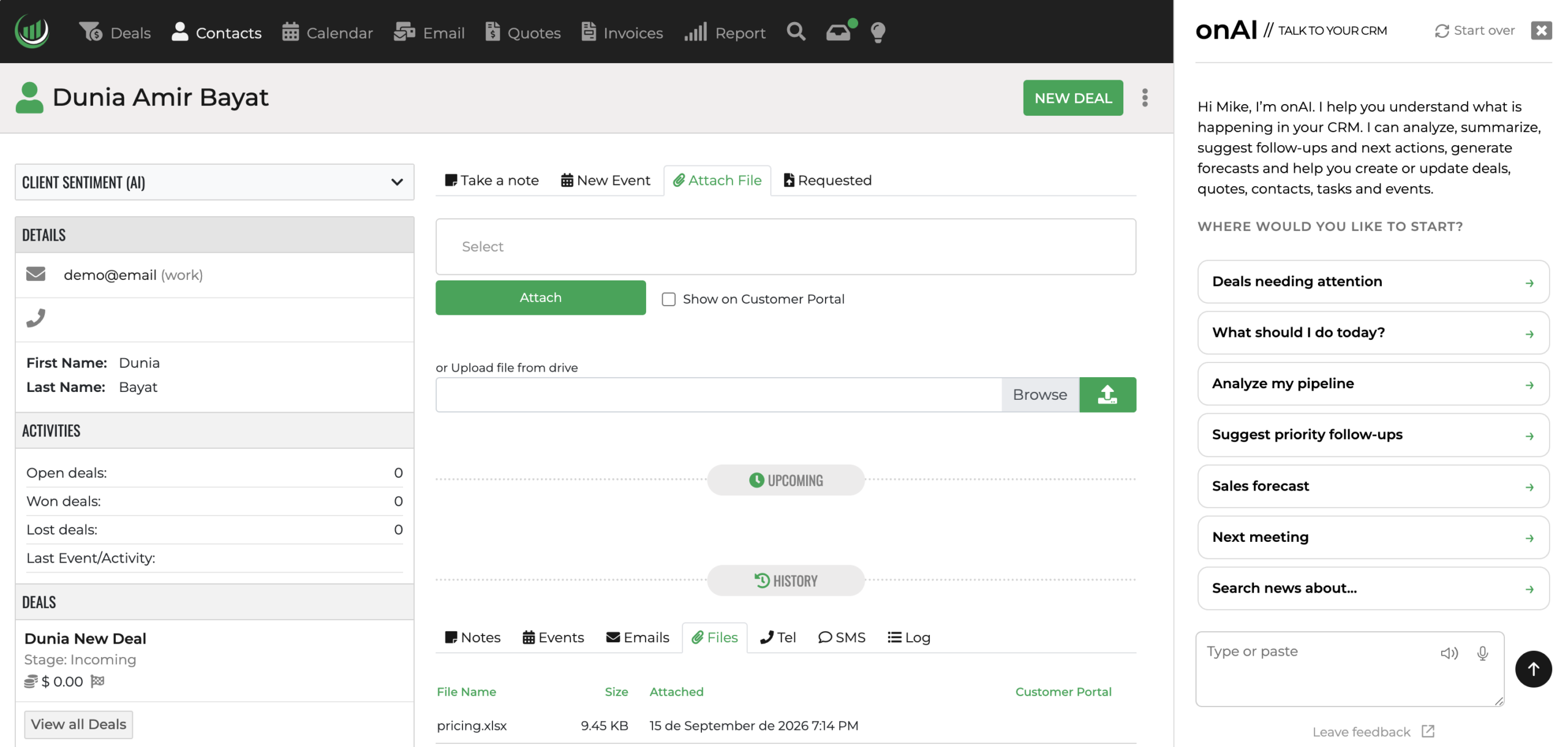
With onAI, we have introduced an additional way of working within that existing environment.
Rather than asking businesses to build their own agents, configure complex instructions, or develop custom integrations for everyday CRM tasks, we provide AI with a set of purpose-built operational tools that interact directly with the platform.
These tools allow users to work with their CRM through natural language.
They can retrieve customer information, analyze sales performance, explore forecasts, identify inactive opportunities, create and update records, manage activities, prepare quotes and revisions, initiate electronic signature workflows, and prepare emails.
Multiple related operations can also be combined into a single workflow.
For example, a sales representative might ask:
“Create a $12,000 quote for Sarah Miller, use her open deal, and send it for signature.”
onAI can identify the customer, locate the relevant opportunity, prepare the quote, generate the document, and arrange the signature request for review and confirmation.
What would otherwise require navigating several areas of the CRM can be prepared through a single natural-language request.
The user does not need to build an agent, understand prompt engineering, or design an automation workflow from scratch.
The operational tools are already there.
Real actions, not just generated answers
We believe the value of AI in a CRM goes beyond generating text or answering questions. Its real potential lies in its ability to interact with business processes.
onAI operates within the structured environment of Onpipeline, using the CRM’s available data and supported operational capabilities.
It is designed to work with the platform rather than create a parallel system outside it.
This distinction matters because business software is not merely about producing plausible answers. It is about performing meaningful operations on real business information.
A quote must contain the right products and prices. A deal must belong to the correct customer. A signature request must be associated with the appropriate document.
AI needs more than conversational ability to accomplish these tasks. It needs structured tools, business logic, and an operational context.
Keeping people in control
Speed should not come at the expense of accountability.
onAI respects the permissions of the authenticated CRM user. It cannot independently extend those permissions to access information or perform operations outside the user’s authorized scope.
When a workflow involves critical changes or operational actions, users can review the proposed steps before execution. Supported changes are recorded and can be reversed.
For email preparation, onAI can populate the CRM’s email composer while leaving the actual sending decision to the user.
The idea is not to create unnecessary approval steps, but to preserve control where it matters.
We want artificial intelligence to make business operations easier without making them less transparent.
AI when you need it, CRM whenever you need it
One of the fundamental principles behind our approach is that AI should remain optional.
Users can work entirely through the conventional CRM interface. They can use built-in automation, interact with onAI, or combine these approaches depending on the task.
A sales manager might use AI to analyze the pipeline in the morning, update a deal manually during a meeting, and prepare a quote through natural language in the afternoon.
There is no need to choose between traditional software and artificial intelligence.
Both belong in the same working environment.
Our responsibility as a software provider is to make each of these experiences as useful, intuitive, and reliable as possible.
We are not trying to turn every CRM user into an AI specialist.
We are building tools that allow people to benefit from increasingly sophisticated technology while continuing to focus on what they actually do: managing customers, selling products and services, and growing their businesses.
Keeping one foot in the real world
Artificial intelligence will continue to evolve. Agents will become more capable, automation will become more sophisticated, and the boundaries between human and machine-driven work will continue to change.
We welcome that evolution.
But businesses operate in the real world, where customer relationships matter, commitments have consequences, resources are limited, and technology must ultimately justify its cost. At Onpipeline, we believe that a CRM should be worth using even without artificial intelligence, and become significantly more useful with it.
You don’t need to build AI agents to benefit from AI. You need the right tools to run your business.