
 Free quiz to know your sales aptitude
 Sales Pipeline Calculator
A Kanban board for sales is not just a visual layout inside your CRM. When used properly, it becomes a system for diagnosing constraints, stabilizing cycle time, and engineering predictable revenue.
This is where a structured sales pipeline CRM becomes critical: not just to visualize deals, but to actively manage flow and remove bottlenecks. The difference between tracking deals and managing flow is the difference between hoping and controlling.
Most sales leaders obsess over pipeline value, win rates, and close probabilities. They rarely manage pipeline flow.
Flow determines Revenue
In operations theory, every system produces output based on one limiting factor:
its constraint.
Manufacturing plants have bottleneck machines. Software teams have deployment limits. Logistics networks have capacity thresholds.
Sales organizations are no different.
Your revenue is not determined by how many deals enter your sales pipeline. It is determined by how many deals can pass through your slowest stage consistently.
That stage is your constraint.

When deals accumulate disproportionately in one stage – proposal, legal review, procurement, negotiation – that is not random. It is structural pressure.
And until the constraint is addressed, increasing top-of-funnel volume only amplifies congestion.
Most Sales Teams misuse Kanban
Many CRM platforms include a Kanban-style view. Dragging cards across columns feels productive. But without structural discipline, it becomes cosmetic.
A true sales Kanban system requires:
• Clear entry criteria for each stage
• Defined expectations for stage duration
• Continuous monitoring of deal aging
• Awareness of capacity limits
• Leadership willingness to address constraints
Without these elements, Kanban becomes visual decoration.
Why Pipeline Value is a Deceptive Metric
Consider two companies with identical pipeline coverage. Both show 4x quota in open opportunities. Both project similar win rates. One closes consistently. The other misses repeatedly.
Why?
Because pipeline value is static. Flow is dynamic.
If opportunities remain stuck in late stages beyond their expected cycle time, their probability of closing declines sharply — even if the CRM still labels them as “commit.”
Sales leaders often treat deals as independent events. In reality, deals interact. They compete for attention, internal approvals, and rep capacity.
When too many opportunities cluster in a single stage, conversion probability drops system-wide. Kanban exposes this clustering effect in real time.
Cycle Time
When cycle time is unstable — when some deals close in 20 days and others drift for 120 — forecasting becomes speculative. Variability destroys predictability.

A Kanban system forces you to confront cycle time stage by stage. If discovery consistently takes longer than expected, qualification criteria may be unclear.
If negotiation drags, pricing authority or value articulation may be weak. By visualizing progression instead of just totals, Kanban transforms cycle time from a historical metric into a live diagnostic tool.
Predictable revenue begins with stable flow.
Overloaded Sales Teams
There is a behavioral component most pipeline discussions ignore:
human attention!
When a rep manages too many active high-stage opportunities simultaneously, attention fragments. Follow-ups become reactive instead of strategic. Messaging loses sharpness. Small delays accumulate.
The pipeline may look full, but performance deteriorates quietly.
Kanban reveals overload instantly. When one column becomes saturated, it signals that capacity has been exceeded.
High-performing teams apply work-in-progress discipline. They limit the number of active late-stage deals per rep, even if it feels counterintuitive. The result is sharper focus, shorter follow-up intervals, and higher close rates.
Throughput improves not because activity increases, but because friction decreases.
Deal Aging
In traditional CRM reporting, aging analysis happens at the end of the month or quarter. By then, it is too late. Kanban transforms aging into a visible signal. When a deal remains in one column longer than its expected duration, it becomes obvious.
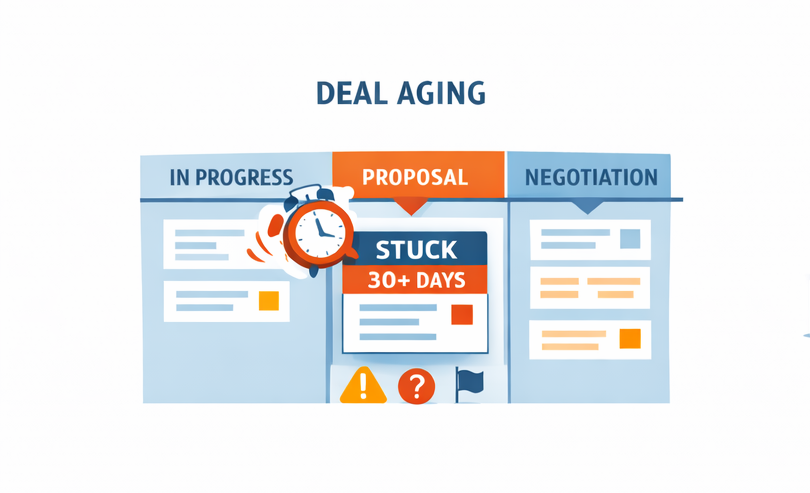
That stagnation is not a rep failure. It is a system message. It may indicate:
• Weak qualification at entry
• Misalignment in buyer authority
• Internal pricing bottlenecks
• Procurement complexity
• Competitive uncertainty
Instead of asking “Will this close?” the better question becomes “Why is it not moving?”
When leadership intervenes early, quarter-end volatility decreases dramatically.
Identifying the True Constraint
According to the Theory of Constraints, improving non-bottleneck stages does not increase total output. Only improving the constraint increases throughput.
In sales, that means:
- If legal review is the slowest stage, adding prospects/deals will not increase revenue.
- If proposal generation is delayed, hiring more SDRs will not fix closing velocity.
Kanban helps identify the constraint by showing where deals accumulate disproportionately and consistently.
Instead of pushing the entire organization harder, you relieve pressure at the narrowest point. That single adjustment can increase throughput more than doubling top-of-funnel activity.
Kanban Changes the Nature of Sales
Traditional pipeline reviews focus on outcomes.
“What will close this month?”
“What is commit?”
“What slipped?”
Kanban-driven reviews focus on flow integrity.
“Where is cycle time expanding?”
“Which stage is exceeding capacity?”
“Are we feeding the constraint or starving it?”
This reframes leadership from reactive to systemic.
Rather than pressuring reps to accelerate deals artificially, leaders redesign the sales process to remove friction. When the system improves, individual performance stabilizes naturally.
Flow and Revenue Predictability
Revenue predictability is not primarily a forecasting problem.
It is a stability problem.
When stage progression is consistent, cycle time variability decreases. When variability decreases, forecasting confidence increases.
Kanban enforces stage clarity. It forces organizations to define what “qualified” actually means. It makes ambiguous transitions visible.
The Competitive Advantage
In competitive B2B markets, especially in the U.S., execution speed and consistency directly impact valuation, investor confidence, and strategic flexibility.
Organizations that manage flow outperform those that manage volume. They experience:
• Shorter close cycles
• Lower quarter-end stress
• Higher rep productivity
• More stable forecasts
• Greater confidence in scaling
The advantage is not aesthetic.
Kanban is a Revenue System
As lead volume increases, pipeline bottlenecks intensify.
Kanban provides early warning signals before collapse occurs. It allows leadership to design capacity intentionally instead of discovering limits accidentally.
A Kanban board for sales is not about visualization. It is about engineering flow, identifying constraints, stabilizing cycle time, and protecting cognitive focus.
It is inevitable.