
 Free quiz to know your sales aptitude
 Sales Pipeline Calculator
The challenge in B2B sales isn’t selling. It’s selling well.
Buyers are more informed than ever. Before they agree to a call, they’ve already compared vendors, read reviews, checked LinkedIn profiles, asked peers for recommendations. By the time they speak with a sales rep, they’re not looking for information. They’re looking for
- Clarity
- Confidence
- Validation
Selling is no longer about presenting. It’s about managing the conversation.
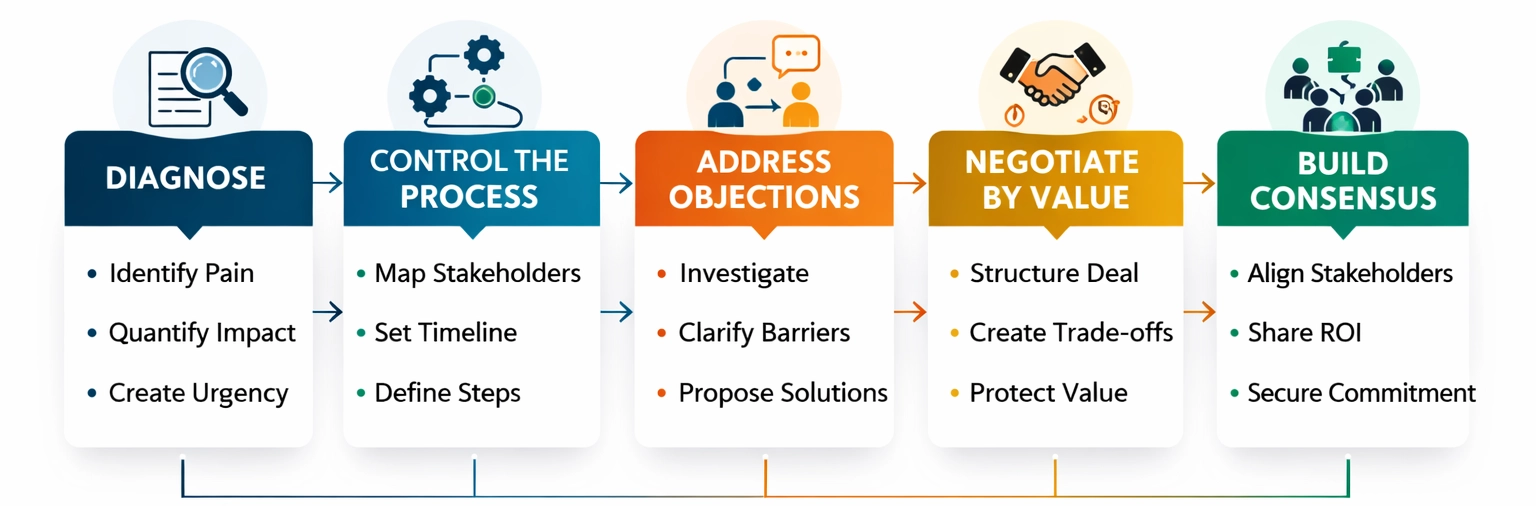
The end of the traditional pitch
For years, sales performance was measured by how well someone could tell the product story. Features. Capabilities. Competitive advantages.
The more a rep talks, the less authority they often project.
Today’s buyer doesn’t need a detailed walkthrough. They need help understanding whether the problem they’re facing is urgent, and what it’s costing them to leave it unresolved.
It’s no longer enough to ask, “What challenges are you facing?”
The stronger question is:
What is this costing you (in time, margin, or risk)?
When a problem is translated into economic or strategic impact, the tone of the deal shifts. The conversation moves from evaluating options to making decisions.
The invisible control of the deal
Another major shift in selling isn’t about persuasion, it’s about process.
Deals don’t die loudly anymore.
“We need to discuss internally.”
“Let us circle back.”
“We’re reviewing options.”
Behind every decision sits a structure: stakeholders, approval steps, competing priorities, budget cycles. If that structure remains unclear, momentum fades.
- Asking who is involved
- Clarifying timelines
- Understanding competing initiatives
This isn’t pressure. It’s professionalism.
The seller who understands the buying process controls the trajectory of the deal.
Objections aren’t what they used to be
You rarely hear “It’s too expensive” anymore. Modern sales objections are softer, but more complex. The mistake is to respond immediately.
The smarter move is to go deeper.
If it’s “not a priority,” what is?
If it’s “under review,” what criteria matter most?
If it’s “later,” what would need to change for it to become urgent?
In many cases, objections mask one of four realities:
- The pain isn’t quantified
- The internal consensus isn’t built
- The perceived risk is too high
- The value isn’t fully understood
Until the real barrier surfaces, the deal remains fragile.
Negotiation is no longer a battle
Price pressure is constant and competitor comparisons are instant. But effective negotiation isn’t a race to the bottom. It’s structured exchange.
- Discounts without conditions weaken positioning
- Concessions without reciprocity erode credibility
The difference between reactive discounting and structured negotiation is decisive.
Selling now means building alignment
Even outside large enterprise environments, B2B decisions are rarely individual anymore.
There’s
- the economic buyer
- the operational user
- the risk-sensitive stakeholder
If one of them isn’t aligned, momentum slows. That’s why selling is less about individual persuasion and more about consensus building.
The modern sales professional doesn’t “close” a person, they facilitate alignment across a small internal network.
Method over charisma
The myth of the charismatic closer is fading. In today’s B2B landscape, performance correlates less with charm and more with structure.
The teams outperforming share common traits:
- Deeper discovery
- Quantified value
- Clear process control
- Mature objection handling
- Strategic negotiation discipline
This isn’t about being aggressive. It’s about being intentional.