
 Free quiz to know your sales aptitude
 Sales Pipeline Calculator
For years, buying a CRM felt like choosing a Swiss Army knife.
One tool. Everything inside. Problem solved.
Sales, marketing, customer support, reporting — just pick a platform that “does it all” and your operations will magically become more efficient.
 Except… that’s not what usually happens.
As companies grow, that all-in-one promise starts to crack. Not in a dramatic way, but quietly: through friction, low adoption, and missed opportunities that don’t immediately show up on a dashboard.
And that’s where things get expensive.
The Cost You Don’t See (At First)
Let’s start with something simple.
A company without a CRM is usually messy:
- leads scattered
- follow-ups missed
- no clear pipeline
Nothing surprising there.
What is surprising is how much that costs.
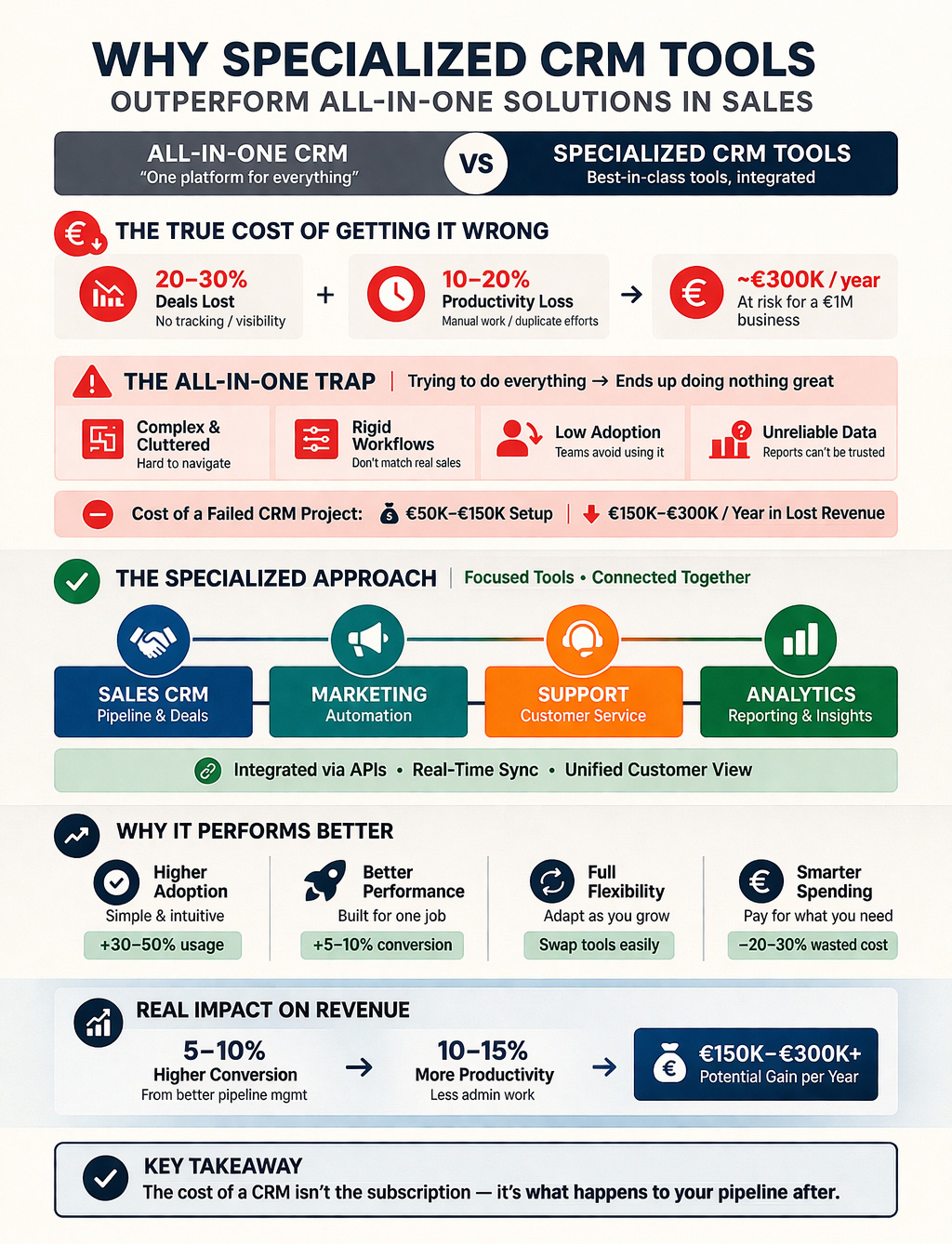
Even with a decent sales team, it’s common to lose somewhere in the range of 20–30% of potential deals just because no one is really tracking what’s going on. Add another 10–20% productivity loss from time wasted searching for information or duplicating work, and the impact starts to compound.
For a $1M business, that’s not a rounding error. You’re easily looking at something in the ballpark of $300k per year slipping through the cracks.
So yes, having a CRM matters.
But here’s the uncomfortable part.
When the CRM Becomes the Problem
Most companies try to fix the situation by implementing a CRM. Makes sense!
But instead of choosing a crm that fits how they work, they go for the “complete solution.” The platform that promises to handle everything.
And this is where things subtly go wrong.
Because the moment a CRM tries to do everything, it starts to compromise on the one thing that actually matters: being useful in daily work!
The All-in-One Trap
All-in-one CRMs don’t fail because they’re bad products.
They fail because they’re trying to solve too many problems at once.
The result?
- Interfaces become heavier
- Workflows become generic
- Teams spend more time managing the tool than using it
And adoption drops! Not dramatically. Just enough to hurt.
Maybe salespeople update deals less frequently.
Maybe data isn’t fully accurate.
Maybe reports are “kind of right” but not really trusted.
Individually, these don’t seem like big issues.
Together, they quietly reduce performance.
Even a 5–10% drop in efficiency or conversion – which is very easy to miss – can translate into tens or hundreds of thousands in lost revenue over a year.
Paying More, Getting Less
Then there’s the financial side.
A typical CRM project (licenses, setup, internal time) can easily land in the $50k–$150k range for a mid-sized company. That’s fine, if it works.
But when adoption is partial and processes don’t fit, you’re not just wasting that investment.
You’re also:
- losing deals due to poor visibility
- making decisions on incomplete data
- slowing down your sales team
Put it all together, and it’s not unrealistic to see a $150k–$300k annual impact when a CRM underperforms.
Not because of one big failure — but because of many small ones.
Why Specialized Tools Feel Different
Now compare that with a different approach.
Instead of one system doing everything, you use:
- a CRM focused purely on sales
- a tool dedicated to marketing automation
- a separate system for customer support
Each one built for its job.
At first, it sounds more complicated.
In practice, it’s usually the opposite.
Because each tool is:
- simpler
- more aligned with how people actually work
- easier to adopt
And adoption is everything.
A simpler tool that people actually use will almost always outperform a more powerful one that they avoid.
Performance Comes from Focus
There’s also a deeper reason why this works.
Specialized tools don’t try to cover edge cases across departments. They go deep on one problem.
A sales CRM, for example, is designed around:
- pipeline clarity
- deal progression
- follow-ups
Not marketing automation. Not ticketing systems. Not everything else.
That focus shows up in daily use:
- fewer clicks
- clearer workflows
- faster execution
And over time, small improvements like that compound.
Even a modest 5–10% increase in conversion rate or sales productivity can more than justify the cost of having multiple tools.
What About Integration?
This used to be the main objection.
“Multiple tools = integration nightmare.”
That was true 10 years ago.
Today, most modern CRM tools are built to connect:
- native integrations
- APIs
- real-time sync
So the real challenge is no longer technical.
It’s choosing the right setup.
Rethinking CRM
The mistake companies make is not choosing the wrong software.
It’s asking the wrong question.
Instead of:
“Which CRM does everything?”
The better question is:
 “What helps my sales team perform better every day?”
Sometimes, that’s an all-in-one tool.
But more often – especially as complexity grows – it’s a combination of specialized tools working together.
Final Thought
The cost of a CRM is not the subscription. It’s what happens to your pipeline after you implement it. If your team moves faster, follows up better, and closes more deals, the system is working.
Onpipeline is built with a clear focus on sales performance. It doesn’t try to do everything. It focuses on what matters: helping sales teams manage pipelines, stay organized, and close deals more effectively. And when combined with other specialized tools, it becomes part of a system that actually works the way modern teams do.