
 Free quiz to know your sales aptitude
 Sales Pipeline Calculator
A stalled deal is an open sales opportunity that has stopped making meaningful progress. Typical warning signs include no recent activity, no scheduled next step, repeated changes to the expected close date, or excessive time in the same pipeline stage.
Building a sales pipeline is important. Keeping deals moving through it is what generates revenue.
One of the biggest misconceptions in sales is that opportunities are usually lost to competitors. In reality, many deals never reach a final decision. They simply stop progressing.
At Onpipeline, we see this pattern every day. Sales teams often focus on creating more opportunities when the real problem lies elsewhere. The issue is not always pipeline generation. More often, it is pipeline management.
A healthy sales pipeline is not defined by the number of deals it contains. It is defined by how consistently those deals move from one stage to the next.
According to research by Matthew Dixon and Ted McKenna – Stop Losing Sales to Customer Indecision – between 40% and 60% of deals are lost to customer indecision rather than competitive losses.
Before we dive in, it’s important to clarify that this article focuses on B2B sales. In complex sales environments, opportunities rarely depend on a single decision-maker or a short buying cycle. Deals often involve multiple stakeholders, internal approvals, and several pipeline stages before a purchase is made. That’s why keeping deals moving requires more than simply generating pipeline. It requires a disciplined approach to pipeline management and a clear understanding of how opportunities progress through the sales process.
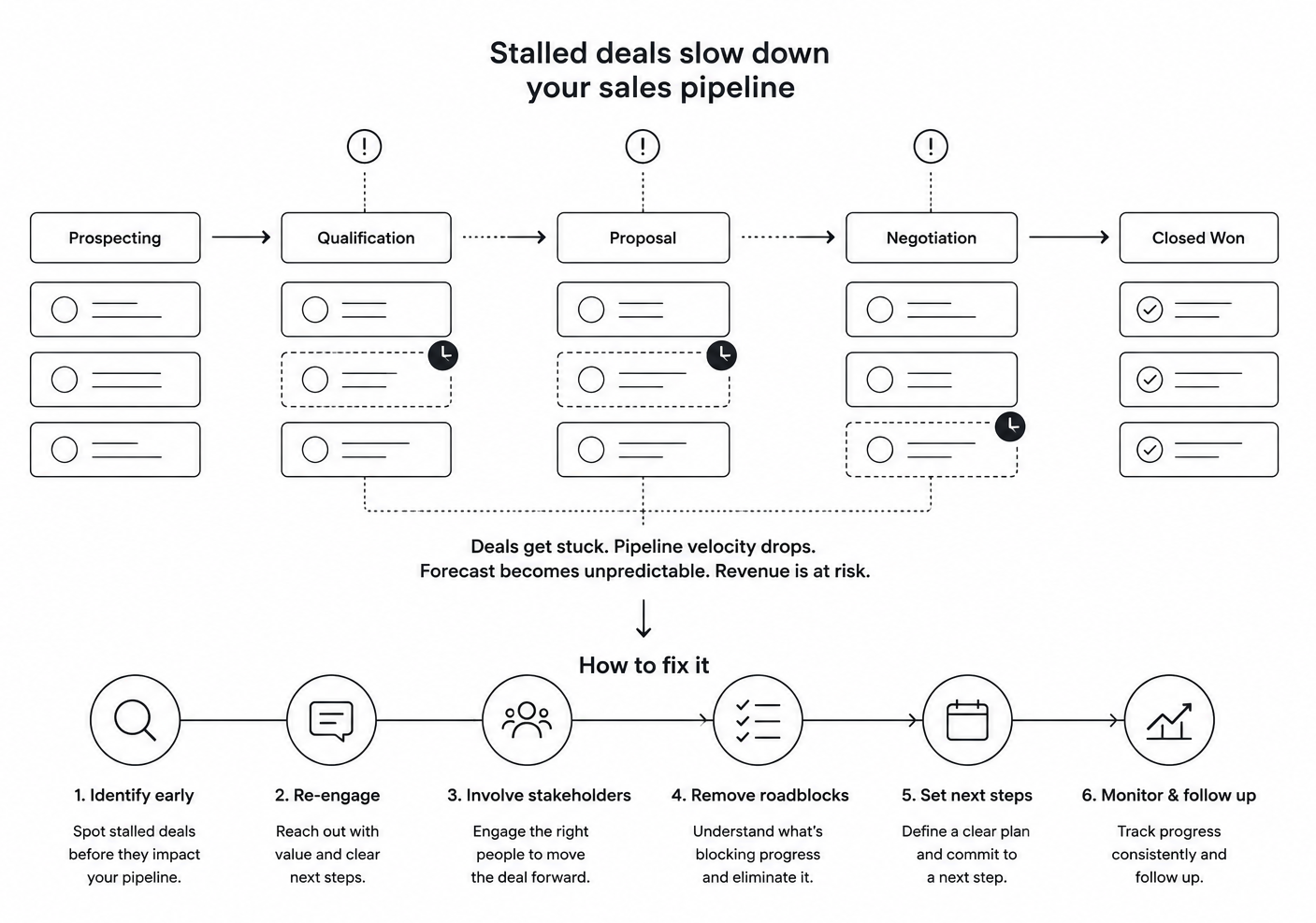
How to recognize and recover stalled deals
Not every opportunity that goes quiet is lost. Not every inactive deal deserves to stay in your active pipeline either.
One of the biggest challenges in B2B sales is recognizing when a deal is slowing down before it disappears from the forecast. Most stalled opportunities don’t stop overnight. They gradually lose traction.
At Onpipeline, we’ve found that stalled deals often share a few common warning signs.
Common signs of a stalled deal
- No activity in the last 30 days
- No next meeting scheduled
- The expected close date has been pushed multiple times
- Only one contact is involved
- A proposal was sent weeks ago with no feedback
- The opportunity has remained in the same stage for too long
- The prospect keeps saying, “We’ll get back to you.”
Recognizing these signals early gives sales teams a chance to take action before opportunities become lost deals.
How to recover stalled deals
Not every stalled deal should be abandoned. In many cases, opportunities simply need a new approach.
Re-engage with value
Avoid sending another “Just checking in” email.
Instead, bring something useful to the conversation:
- Industry insights
- New use cases
- Customer success stories
- Relevant market trends
Give prospects a reason to restart the discussion.
Involve additional stakeholders
Sometimes the original contact supports the project but lacks the authority to move it forward. Broadening the conversation to include managers, finance, operations, or technical teams can help restart the buying process.
Requalify the opportunity
Priorities change.
Confirm that:
- The problem still exists
- Budget expectations are unchanged
- The timeline is still realistic
- The initiative remains important
Not every opportunity that looked promising three months ago still deserves attention today.
Know when to let go
Keeping dead opportunities in the CRM creates false expectations and affects forecast accuracy. Sometimes the healthiest decision is to close the deal, learn from it, and focus on opportunities with a higher chance of success.
Because pipeline health is not about keeping every deal alive. It’s about helping the right deals move forward.
1. Stop confusing activity with progress
Sales teams are busy. Calls are scheduled, emails are sent, demos are delivered, and proposals are shared.
But sales activity does not necessarily mean progress.
A deal has only moved forward when something has changed:
- A business challenge has been clarified
- Additional stakeholders have joined the conversation
- Budget expectations have been discussed
- The buying process has become clearer
- A new milestone has been agreed upon
Many opportunities appear active because there are frequent interactions. In reality, nothing is changing.
Questions to ask after every meeting
Before moving a deal forward, ask yourself:
- What did we learn?
- What changed?
- What is the next step?
- Who else should be involved?
Conversation Template
Instead of ending with:
“Thanks for your time. Let us know what you think.”
Try:
Before we wrap up, I want to make sure we are aligned. What do you think should happen next to keep this project moving?
Simple questions often create more progress than another presentation.
2. Focus on active deals, not pipeline size
Large pipelines can create a false sense of security.
Having 200 opportunities in the CRM means very little if half of them have not moved in over a month. At Onpipeline, we encourage sales teams to focus on pipeline quality rather than volume.
Some useful indicators include:
- Days spent in each stage
- Time since the last activity
- Number of stakeholders involved
- Scheduled next meetings
- Expected close dates
Example
Imagine an opportunity that entered the Proposal stage 45 days ago.
No new meetings have been scheduled.
The prospect has stopped replying.
The close date has already been pushed twice.
Technically, the deal is still open. Realistically, it probably belongs somewhere else.
Keeping inactive opportunities open creates inaccurate forecasts and distracts sales teams from real opportunities.
3. Identify delays before they become problems
Deals rarely stop because prospects suddenly lose interest.
More often, internal factors slow down the process:
- Budget approvals
- Procurement procedures
- Competing priorities
- Changes in leadership
- Lack of internal consensus
The best sales teams address these issues early instead of waiting for surprises.
Questions we recommend asking
Besides budget, are there any approvals required?
Who else should be involved in the evaluation?
Are there competing initiatives we should consider?
Is there a specific timeline you need to follow?
These questions create visibility and help avoid unexpected delays later.
Example
Many sales reps hear:
“Everything looks good. We just need final approval.”

What sounds like a formality can easily add another six weeks to the process.
Understanding internal requirements early helps set realistic expectations.
4. Involve more stakeholders early
One of the biggest risks in B2B sales is relying on a single contact.
Even highly engaged contacts may not have enough influence to drive the decision internally.
Modern buying decisions often involve several people:
- Department managers
- Finance teams
- Operations
- IT
- Executives
The earlier these stakeholders become involved, the easier it becomes to move the opportunity forward.
According to Gartner, 74% of B2B buying teams experience unhealthy conflict during the decision-making process, which can slow down or completely derail opportunitie
Stakeholder Mapping Template
| Stakeholder | Main Question |
| Decision-maker | What business goals are driving this initiative? |
| Operations | How will this impact current processes? |
| Finance | How will success be measured? |
| IT | Are there technical concerns? |
| Leadership | How does this support company priorities? |
Single-contact deals are fragile.
Broader engagement creates stronger opportunities.
5. Define clear criteria for every stage
Pipeline stages should reflect buyer progress, not sales activities.
Completing a demo does not automatically mean a deal is ready for a proposal.
Clear stage definitions improve forecasting and create consistency across the sales team.
Discovery Stage
Before moving forward, make sure:
✔ The business problem has been identified.
✔ Key priorities have been discussed.
✔ Decision-makers are known.
✔ The buying process is understood.
Evaluation Stage
✔ Additional stakeholders are involved.
✔ Budget expectations have been discussed.
✔ Timeline expectations are clear.
✔ Technical requirements have been reviewed.
Proposal Stage
✔ Requirements are confirmed.
✔ Decision criteria are understood.
✔ Next meetings are scheduled.
✔ Implementation expectations are aligned.
Without clear criteria, pipeline stages quickly become subjective.
6. Never finish a meeting without a next step
Many opportunities become inactive because meetings end with vague statements:
“Let’s reconnect soon.”
“We’ll review internally and get back to you.”
These phrases create uncertainty and delays.
Every meeting should end with:
- A specific action
- A responsible person
- A date
Example of a Weak Next Step
“Let’s stay in touch.”
Example of a Strong Next Step
We’ll send the proposal by Friday and schedule a review call next Tuesday with your operations manager.
Follow-Up Email Template
Subject: Next Steps
Hi Sarah,
Thank you again for today’s conversation.
As discussed:
– We’ll send the updated proposal by Friday.
– Your team will review it internally.
– We’ll reconnect next Tuesday at 10 AM to discuss feedback and answer any questions.
Looking forward to speaking again.
Best regards,
Simple follow-ups help maintain continuity and prevent deals from going quiet.
7. Review your pipeline every week
Pipeline management should not happen only at the end of the quarter.
The most effective sales teams review pipeline health regularly.
Weekly Pipeline Checklist
Review opportunities that:
✔ Have had no activity for more than 30 days.
✔ Have no next meeting scheduled.
✔ Depend on only one contact.
✔ Have unrealistic close dates.
✔ Have remained in the same stage for too long.
✔ Should probably be marked as Closed Lost.
Keeping the CRM clean improves forecasting and helps teams focus on opportunities with real potential.
Final Thoughts
A pipeline full of inactive opportunities creates noise.
A pipeline full of active opportunities creates visibility, improves forecasting, and helps sales teams focus on the deals that matter most.
Successful sales teams do not just generate pipeline. They continuously help deals move forward.